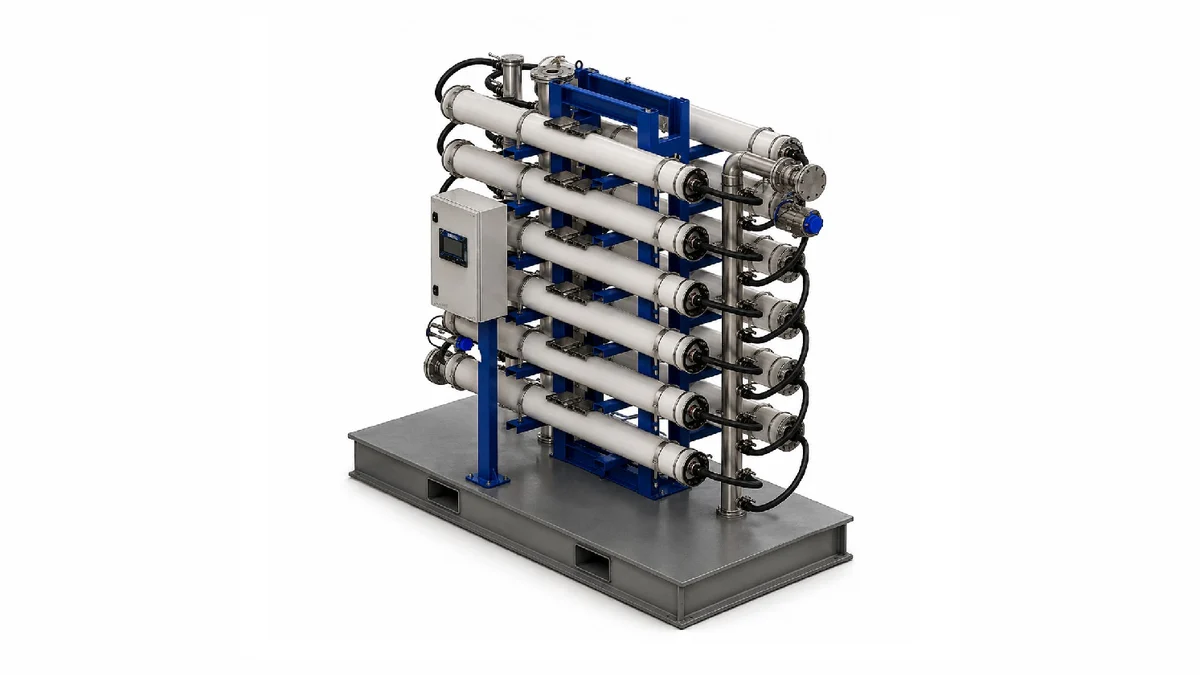
Two ways of separating air without cooling it
To produce nitrogen on site there are two technologies that work at ambient temperature: pressure swing adsorption (PSA) and hollow-fibre membranes. The membrane is sometimes presented as “the new technology”. It is not: gas separation membranes have been used industrially since the 1980s, and nitrogen PSA with carbon sieve has a similar history. Both are mature. The useful question is not which is more modern, but which fits your purity, your flow and the way you operate.
In this article we explain how each works, with just enough physics to understand its limits, and compare the numbers that matter: air consumed, energy, maintenance and sensitivity to operating conditions.
How a membrane works
A membrane module is a bundle of tens or hundreds of thousands of polymer hollow fibres (polysulfone, polyimide or polyphenylene oxide), as thin as a hair, inside a housing. Compressed air enters the bore of the fibres. Some gases cross the wall faster than others and leave through the housing; the rest continues along the bore and leaves at the other end.
Not holes: solution and diffusion
The fibre wall is not a sieve with molecule-sized pores. It is a dense polymer in which each gas first dissolves and then diffuses. A gas's permeability is the product of its solubility in the polymer and its diffusivity within it:
The flow crossing the wall per unit area depends on that permeability, on the thickness of the selective layer l and on the partial-pressure difference between the bore (high pressure, fraction xi) and the housing (low pressure, fraction yi):
Water, CO₂ and oxygen permeate considerably faster than nitrogen and argon. The ratio of oxygen to nitrogen permeability is the membrane's selectivity :
That selectivity has a ceiling. Robeson showed that, for all known polymers, gaining selectivity costs permeability and vice versa. That gives a membrane its two characteristics: it easily removes the first few percent of oxygen and finds it ever harder to approach 100 %. The longer the air spends inside the fibre (less flow), the more oxygen escapes and the purer the nitrogen stream — but the smaller it is.
A balance you can do yourself
We call air factor f the Nm³ of compressed air needed per Nm³ of nitrogen. The oxygen that does not leave with the product has to leave with the permeate, so an oxygen balance gives its composition:
For 98 % N₂ (xO₂ = 0.02) and an air factor of 3.1, the permeate leaves with yO₂ ≈ 0.30. It is air enriched to 30 % oxygen and loaded with moisture, which is vented. Those numbers also give the recovery, the share of the air's nitrogen that ends up in the product:
Temperature: the parameter the data sheet does not always explain
Permeability rises with temperature, and selectivity drops slightly. That is why membrane generators heat the air before the module, usually to a fixed setpoint of about 40–50 °C, and deliver rated flow only at that temperature. A module running colder produces considerably less at the same purity. If you compare quotations, ask at what inlet temperature the flow is stated.
How PSA works, in brief
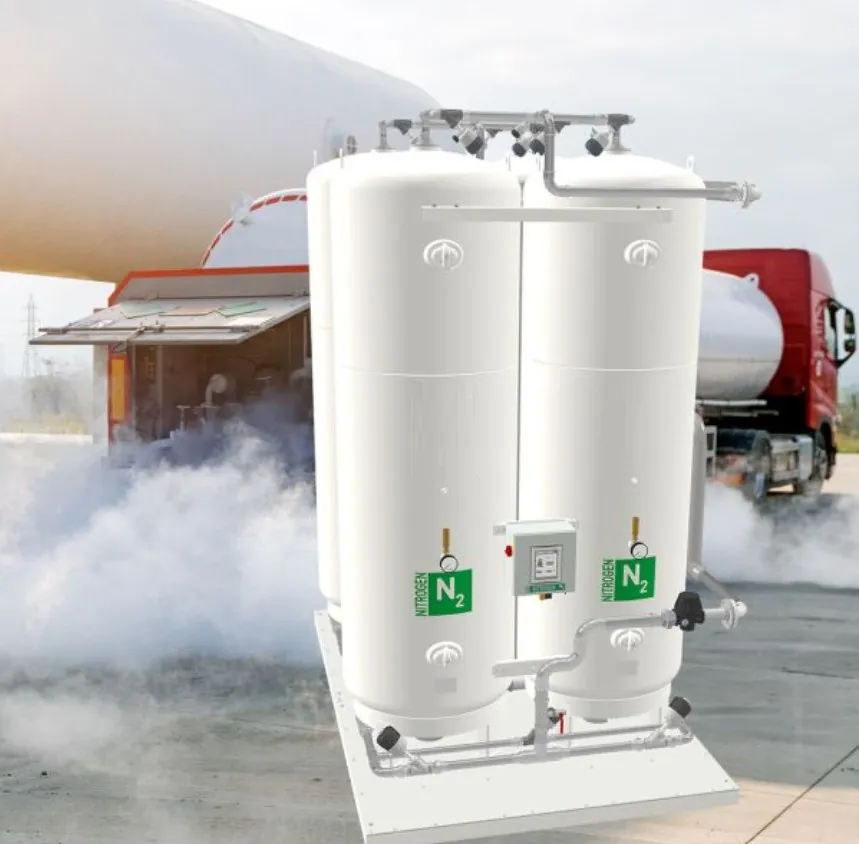
A PSA nitrogen generator has two columns filled with carbon molecular sieve (CMS). Separation is kinetic: the O₂ molecule (kinetic diameter 3.46 Å) enters the carbon micropores much faster than N₂ (3.64 Å), of the order of thirty times faster. While one column produces under pressure, the other depressurises and releases the retained oxygen. The columns switch roughly every minute. We explain it in detail in the PSA technical guide.
Purity is adjusted with cycle time and flow. With a good sieve, 99.999 % is standard.
Air consumed and energy
The air factor determines energy, because almost all of a nitrogen plant's electricity goes to the compressor:
| N₂ purity | PSA air factor | Membrane air factor | kWh/Nm³ PSA | kWh/Nm³ membrane | Difference |
|---|---|---|---|---|---|
| 95 % | 1.9 | 2.1 | 0.21 | 0.23 | +11 % |
| 97 % | 2.2 | 2.7 | 0.24 | 0.30 | +23 % |
| 98 % | 2.4 | 3.1 | 0.26 | 0.34 | +29 % |
| 99 % | 2.6 | 4.2 | 0.29 | 0.46 | +62 % |
| 99.5 % | 3.0 | 5.4 | 0.33 | 0.59 | +80 % |
Indicative values, at 20–25 °C inlet for PSA and at setpoint temperature for membrane. Above 99.5 % the membrane no longer makes energy sense and hardly any manufacturer offers it.
The reading is clear. Up to 95–96 % both technologies consume about the same. From 98 % the difference starts to show on the bill, and at 99 % the membrane uses around 60 % more energy per Nm³. The same physics explains why, when purity goes from 95 % to 99 %, the capacity of the same unit drops by around 60 % for membrane and 45 % for PSA.
An example with numbers
A plant needs 40 Nm³/h of N₂ at 98 % for 4,000 hours a year, with electricity at €0.12/kWh. The energy difference is 0.34 − 0.26 = 0.08 kWh/Nm³; over a year, 160,000 Nm³ × 0.08 = 12,800 kWh, about €1,500. In addition, the membrane needs a 30 % larger compressor. If the same flow is required at 99 %, the annual difference approaches €3,300.
Maintenance, sensitivity and service life
Where the two technologies differ most is in what happens over the years:
- Membrane: no moving parts, but delicate with the air. There are no switching valves or cycles, so routine maintenance is limited to filters and heater. In exchange, the polymer is very sensitive to oil (aerosol and vapour) and liquid water: it plasticises, loses permeability and does not recover. A failure of the air treatment can destroy the module, and replacing it costs, in the quotations we see, between 60 % and 80 % of a new unit.
- Membrane: slow ageing. Even with impeccable air, the polymer compacts and its performance slowly drops: to maintain purity, flow has to be reduced.
- PSA: predictable maintenance. The working parts are the process valves, silencers and filters. Quality valves are rated for about 4 million operations, which with usual cycles means about 40,000 hours — more than 9 years at 12 hours a day. A full overhaul usually costs around 15–20 % of a new unit.
- PSA: the sieve lasts if the air is good. CMS also degrades with oil and liquid water, but with correct treatment it works for many years without replacement.
- Temperature. PSA performs best with air at 20–25 °C and loses capacity if the room heats up. The membrane needs its heater and loses flow if it does not reach the setpoint. In both cases, room ventilation is part of the design.
Summary comparison
| Criterion | PSA (CMS) | Membrane |
|---|---|---|
| Practical purity range | 95 – 99.999 % | 95 – 99.5 % |
| Efficiency above 98 % | Better | Worse, and worsening quickly |
| Moving parts | Process valves | None |
| Start-up | Minutes to stable purity | Almost immediate after warming up |
| Noise and pulsation | Cyclic venting, needs a buffer tank | Quiet and continuous |
| Weight and size | Larger (columns and tanks) | Compact, suitable for mobile units |
| Sensitivity to oil and water | High (CMS) | Very high (polymer) |
| Cost of the main repair | ≈ 15–20 % of a new unit | ≈ 60–80 % (module replacement) |
| Evolution over the years | Stable with good maintenance | Gradual loss of flow |
Cost figures are usual market orders of magnitude and vary with manufacturer and size.
When to choose each?
The membrane makes sense when the purity needed is between 95 % and 98 %, the flow is small or medium and simplicity, space or mobility matter: inerting of tanks and pipes, fire prevention, tyre inflation, mobile units, platforms or intermittent operation with frequent starts.
PSA is the usual option as soon as purity goes above 98–99 % or the unit runs many hours, which is the case in wineries, food packaging, laser cutting, electronics and heat treatment. In the vast majority of wineries we have worked with, PSA is the right choice for energy and maintenance.
In both cases, inlet air quality is not negotiable. Coalescing filtration, drying and, for the membrane, activated carbon, sized for the worst day of summer. Most of the expensive failures we see in nitrogen generators, of either technology, start there. We explain it in the article on gas purity and quality.
Conclusion
Membrane and PSA are two mature technologies with different physics. The membrane is simple, compact and quiet, and shines at moderate purities. PSA is more efficient as soon as purity tightens and its maintenance is cheaper in the long run. To choose, you need four data from your process: purity at the point of use, flow profile, operating hours and your electricity price. With them, the decision can be calculated.
Unsure between membrane and PSA for your installation? With your purity, flow and hours data, we will compare energy and ten-year cost for you.
Let's talk about your project →References
- Baker, R. W. (2012). Membrane Technology and Applications, 3rd ed. Wiley.
- Baker, R. W. (2002). Future directions of membrane gas separation technology. Ind. Eng. Chem. Res. 41, 1393–1411.
- Robeson, L. M. (2008). The upper bound revisited. J. Membr. Sci. 320, 390–400.
- Ruthven, D. M., Farooq, S. and Knaebel, K. S. (1994). Pressure Swing Adsorption. VCH.
- ISO 8573-1:2010. Compressed air — Part 1: Contaminants and purity classes.