Two different questions about the same gas
When someone asks us for “good-quality nitrogen”, they are almost always mixing two questions with independent answers:
- How much of what arrives is nitrogen? That is purity: the concentration of the main gas or, put the other way round, how much residual oxygen comes with it.
- What else comes with it? That is quality: water, oil, particles and, in demanding applications, other traces such as CO, CO₂ or microorganisms.
A gas can be very pure and of poor quality, or not very pure and of excellent quality. Separating the two ideas avoids the two most expensive mistakes we see in plants: paying for purity the process does not need, and neglecting quality it does need.
Purity: a mole fraction
Purity is the mole fraction (in practice, by volume) of the main component. In a PSA or membrane generator the product gas is almost only nitrogen, argon and residual oxygen. Argon, also inert, is not separated and is counted with the nitrogen, so purity is calculated from the oxygen that remains:
That is why, for nitrogen generated on site, the figure worth working with is residual oxygen in ppm. Packaged gas suppliers also use a “grade” notation: the first figure is the number of nines and the second the digit that follows.
| Purity | Residual O₂ | Grade | Typical use |
|---|---|---|---|
| 95 % | 50,000 ppm | — | Inerting, fire prevention |
| 99 % | 10,000 ppm | 2.0 | Legal minimum as food additive E 941 |
| 99.5 % | 5,000 ppm | 2.5 | Wineries, packaging |
| 99.9 % | 1,000 ppm | 3.0 | Demanding packaging, laser cutting |
| 99.99 % | 100 ppm | 4.0 | Electronics, heat treatment |
| 99.999 % | 10 ppm | 5.0 | Laboratory, pharma, semiconductors |
Each additional nine divides residual oxygen by ten. Between 99.5 % and 99.999 % there is a factor of 500.
We have already written about what each “nine” costs in energy. Here we are interested in the other half of the specification.
Quality: what travels with the gas
The contaminants in an industrial gas almost always come from the compressed air it is made from and the network that distributes it. The reference for classifying them is ISO 8573-1:2010, written for compressed air but widely used for gases generated from it. It defines three families of contaminants and assigns each a class, from 0 (the most stringent, to be specified) to 9:
| Class | Particles per m³ 0.1–0.5 / 0.5–1 / 1–5 µm | Water: pressure dew point | Total oil (aerosol + liquid + vapour) |
|---|---|---|---|
| 1 | ≤ 20,000 / ≤ 400 / ≤ 10 | ≤ −70 °C | ≤ 0.01 mg/m³ |
| 2 | ≤ 400,000 / ≤ 6,000 / ≤ 100 | ≤ −40 °C | ≤ 0.1 mg/m³ |
| 3 | — / ≤ 90,000 / ≤ 1,000 | ≤ −20 °C | ≤ 1 mg/m³ |
| 4 | — / — / ≤ 10,000 | ≤ +3 °C | ≤ 5 mg/m³ |
| 5 | — / — / ≤ 100,000 | ≤ +7 °C | — |
Extract from ISO 8573-1:2010, table 1. Concentrations referred to 20 °C, 1 bar abs and 0 % relative humidity. Quality is written as [particles : water : oil]; for example, [1:2:1] means class 1 for particles, dew point −40 °C and oil ≤ 0.01 mg/m³.
Water: dew point and ppm are the same thing
Water is expressed as dew point (the temperature at which it would condense) or as concentration in ppm. You convert from one to the other with the saturation vapour pressure of ice or water, es(T), and the absolute pressure of the gas:
Pressure matters a lot. A pressure dew point of +3 °C at 7 bar, typical of a refrigerated dryer, equals about 950 ppm of water — the same as a dew point of −21 °C at atmospheric pressure. When the gas expands at the point of use its dew point drops, but the water it carries stays the same.
Two readings of the chart. The European Pharmacopoeia limits water in nitrogen to 67 ppm, equivalent to an atmospheric dew point of about −45 °C: a refrigerated dryer is not enough, and adsorption is needed. At the other extreme, a line that accumulates condensate meets no class at all, however pure the generator outlet.
Oil and particles
Oil arrives as aerosol (fine droplets carried over by the lubricated compressor) and as vapour. Coalescing filters retain the aerosol; only an activated-carbon bed stops the vapour. Particles come from ambient air, compressor wear, rust in the network and the molecular sieve itself, which releases some dust over the years. That is why a good design ends with a filter at the point of use, not only at the compressor room outlet.
Purity and quality are independent
If you cross the two ideas you get four very different situations. All four exist in industry, and each calls for a different installation:
The bottom-left case is the most instructive. To inert a tank, 97 % nitrogen with a dew point of +3 °C is perfectly adequate. Asking for 99.999 % there improves nothing and multiplies the cost.
Why with bought-in gas you pay the maximum for both
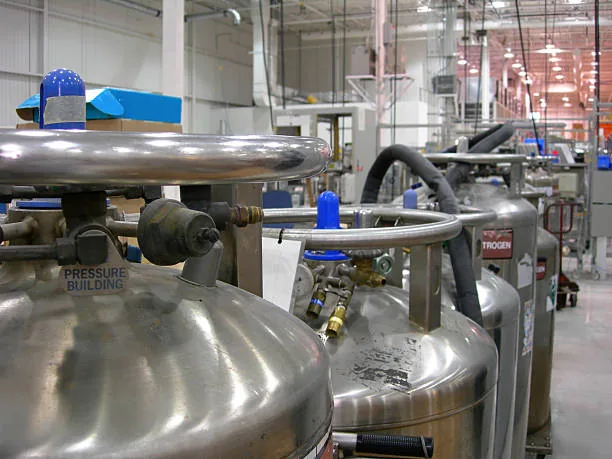
Cryogenic nitrogen is produced by distilling liquefied air. By the very physics of the process it comes out with very high purity (5.0 or more) and practically no water or oil, because at −196 °C everything else has condensed first. It is an excellent gas, but it comes in a single format: maximum purity and maximum quality, at the price of liquefaction energy, transport and tank rental.
Most of the processes we work with do not need that combination. A winery inerting tanks at 99.5 % pays, with liquefied gas, for a factor of 500 in residual oxygen it does not use. The problem is that, after years of liquid supply, 99.999 % appears in the internal specification as if it were a process requirement.
With on-site generation you choose each parameter
In your own plant, purity and quality are decided in different places, and so they can be adjusted separately:
- Purity is set by the generator with its setpoint: cycle time in a PSA, flow in a membrane. Going down from 99.9 % to 99.5 % immediately reduces compressed-air consumption.
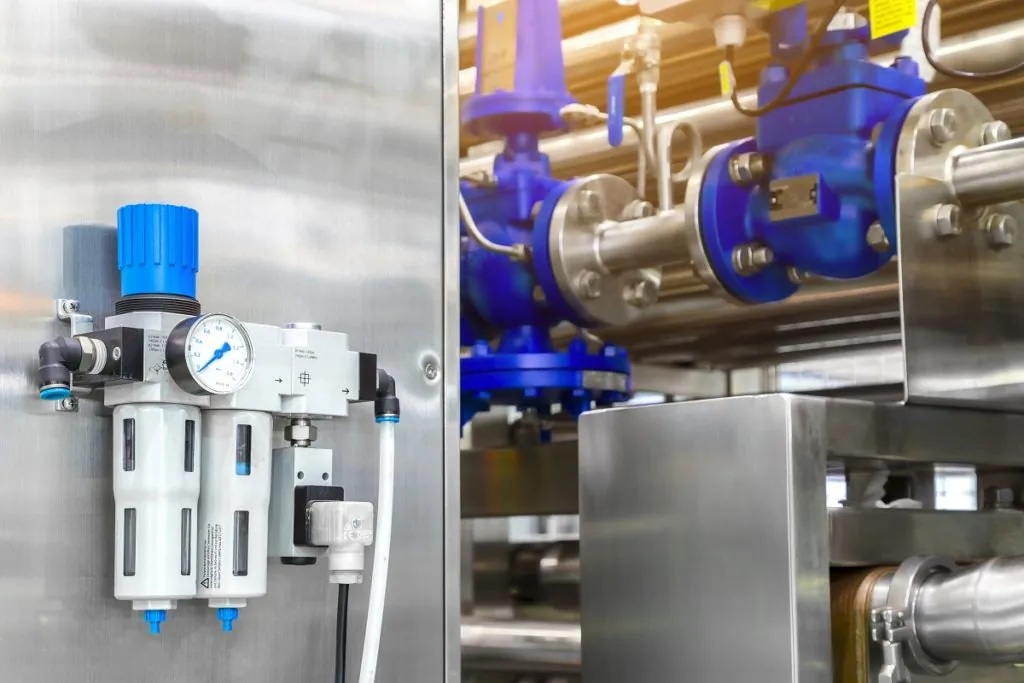
- Quality is set above all by the air treatment: coalescing filters, dryer and, if needed, activated carbon. And it can be lost afterwards, in the tank and the network, if condensate is not drained or unsuitable pipework is used.
- The generator also helps quality. Carbon molecular sieve (CMS) degrades with oil and liquid water, so it needs clean, dry air at the inlet. It also retains part of the water and CO₂ during the cycle. As a result, the N₂ leaving a well-fed PSA is usually drier than the air going in.
How to write a complete specification
A useful specification fits on one line, but it must include all its terms and say where they are met. We suggest this format:
- Purity as maximum oxygen. It is what the analyser measures and what affects the product.
- Quality as ISO 8573-1 class, with the water class expressed as pressure dew point or atmospheric dew point — but saying which.
- Pressure and flow at the point of use, with the peaks and not just the average.
- Measurement point. A specification met in the generation room and lost at the machine is useless.
To verify it you need a calibrated oxygen analyser (electrochemical or zirconia, depending on range), a dew point hygrometer and, where oil is critical, a measurement to ISO 8573-2 and 8573-5. What is not measured periodically ends up drifting.
The minimums set by regulations
- Food: as additive E 941, nitrogen must be at least 99 % pure and meet the limits of Regulation (EU) No 231/2012. For gas in direct contact with food, industry guides (for example, the code of practice of the British association BCAS) recommend at least [2:2:1].
- Pharma: the European Pharmacopoeia “Nitrogen” monograph sets content ≥ 99.5 %, O₂ ≤ 50 ppm, CO₂ ≤ 300 ppm, CO ≤ 5 ppm and water ≤ 67 ppm. Here purity and quality are written together, and with a generator the oxygen limit means working at 99.995 % or above.
Conclusion
Purity and quality are two axes, not one. Purity has a direct energy cost and should be set at the minimum the process tolerates. Quality depends on the air and the network, and should be ensured where the gas touches the product. With bought-in gas you pay the maximum for both; with your own generation you can choose each with judgement — and measure them.
Does your nitrogen specification state purity and quality, and where they are measured? We help you review it with measurements at your plant.
Let's talk about your case →References
- ISO 8573-1:2010. Compressed air — Part 1: Contaminants and purity classes. ISO, Geneva.
- ISO 8573-2, -3, -4 and -5. Test methods for oil aerosol, humidity, particles and oil vapour.
- European Pharmacopoeia, monograph 0194 “Nitrogen”. EDQM, Council of Europe.
- Commission Regulation (EU) No 231/2012, specifications for food additives (E 941).
- Murphy, D. M. and Koop, T. (2005). Review of the vapour pressures of ice and supercooled water for atmospheric applications. Q. J. R. Meteorol. Soc. 131, 1539–1565.