
Technical guide

On-site generation of nitrogen and oxygen at your plant

Self-sufficient production of N₂ and O₂ with PSA technology (Pressure Swing Adsorption): no dependence on trucks or cylinders, lower cost per Nm³ and purity from 95 % to 99.999 %. Here we explain how it works, with simulations you can play with.


The air around us
is the raw material

The atmosphere contains all the N₂ and O₂ needed. PSA technology separates these gases precisely, without cryogenics, without transport and without depending on external suppliers.

N₂ / O₂ Ambient air
Nitrogen (N₂) 78%
Oxygen (O₂) 21%
Argon and others 1%

Separation takes place at ambient temperature, exploiting the difference in the kinetic diameter of the molecules: N₂ (0.364 nm) versus O₂ (0.346 nm).

N₂
Nitrogen
kinetic ∅: 0.364 nm
relative diameter
O₂
Oxygen
kinetic ∅: 0.346 nm
relative diameter

The PSA cycle in 5 stages

01
Start of the cycle

Compressed air (7–10 bar) enters the first tower or column, filled with carbon molecular sieve (CMS) for nitrogen or zeolite for oxygen.

02
Pressurisation

The adsorption pressure in the active tower is raised to the system's design conditions, preparing it for separation.

03
Adsorption

In N₂ generators, O₂ (smaller and faster) is retained in the CMS micropores and N₂ leaves as product. In O₂ generators it is the other way round: the zeolite retains N₂ and O₂ leaves as product.

04
Equalisation

Gas is transferred between the towers in the opposite direction to minimise losses and maximise the energy efficiency of the cycle.

05
Venting and purge

The regenerating tower is depressurised, releasing the adsorbed gases to atmosphere and becoming ready for the next production cycle.


The PSA cycle, in motion

Two towers that alternate: while one produces, the other regenerates. Compare normal operation with a pressure drop at the inlet and you will see why compressed air matters as much as the generator.


Available purity ranges

Purity is set according to the application. The higher the purity required, the higher the air consumption and the lower the output flow. Correct design balances both parameters.

N₂ purity Residual O₂ Typical application Indicative air / N₂ ratio
95% 50,000 ppm General inerting, blowing ~1.9 : 1
99% 10,000 ppm Food, aquaculture ~2.5 : 1
99.5% 5,000 ppm Heat treatment, welding ~3.3 : 1
99.9% 1,000 ppm Laser cutting ~3.8 : 1
99.99% 100 ppm Laboratory, electronics ~5.8 : 1
99.999% 10 ppm Semiconductors, optics, pharma (Ph. Eur.) ~7.0 : 1

Air quality: ISO 8573-1:2010

Gas purity is independent of the quality of the inlet air. ISO 8573-1 classifies compressed air by three parameters: solid particles, dew point and oil content.

ISO class Particles (0.1–0.5 µm) Dew point (°C) Oil (mg/m³)
Class 1 100 part./m³ −70°C 0.01
Class 2 N₂ / O₂ 100,000 part./m³ −40°C 0.1
Class 3 — −20°C 1
Class 4 — +3°C 5

PSA generators require inlet air of at least Class 2 for particles and oil, and a dew point ≤ +3°C (preferably −40°C) to protect the adsorbent.


How purity is guaranteed

Two oxygen sensors and two valves that never open at the same time: only on-spec nitrogen reaches your process. Choose a situation and see what the plant does.

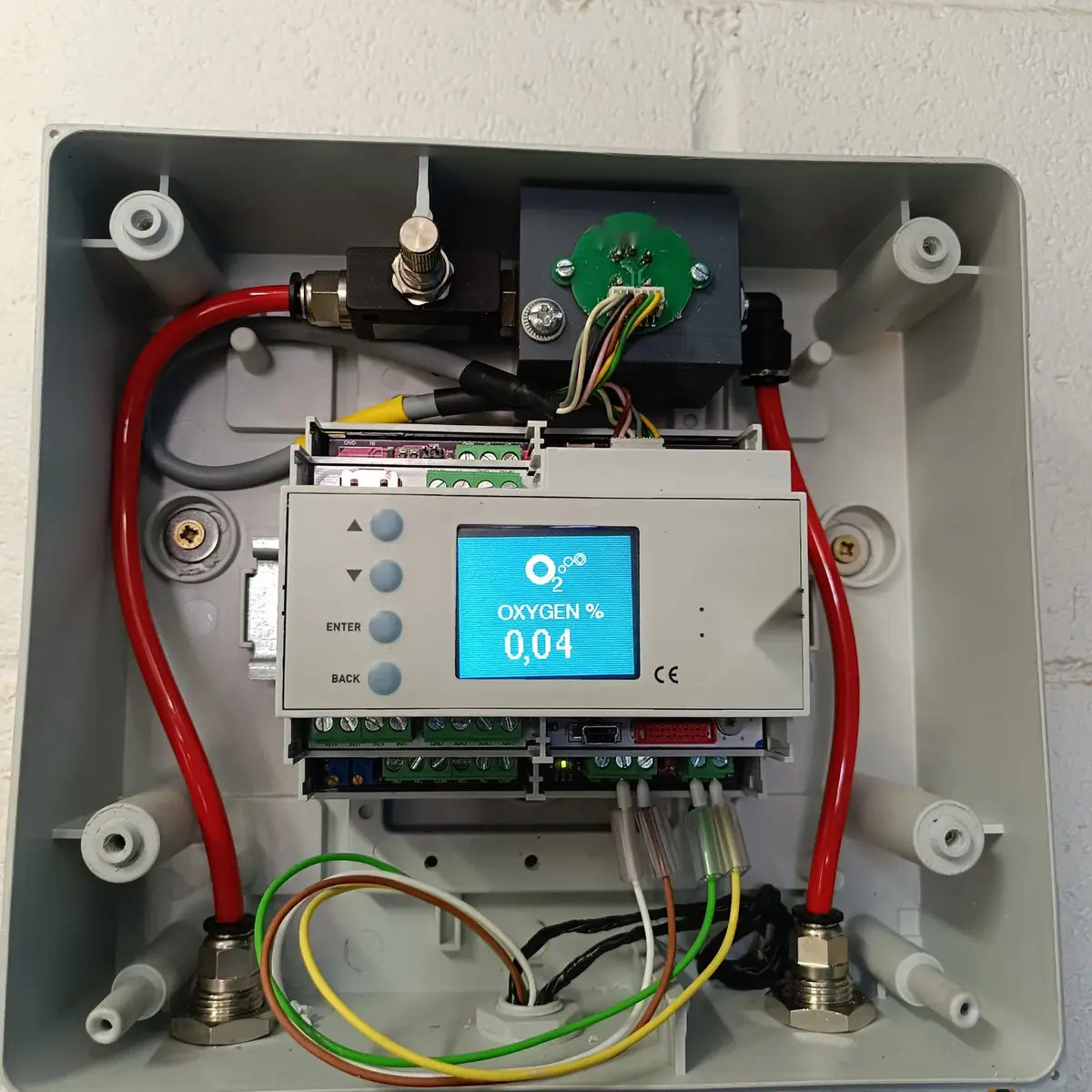
Oxygen analyser of a nitrogen generator reading 0.04 % O₂

Purity monitored continuously

The generator analyser measures residual oxygen non-stop. 0.04 % O₂ equals 99.96 % N₂. If oxygen rises above the limit, the safety valve diverts the gas before it reaches the process.

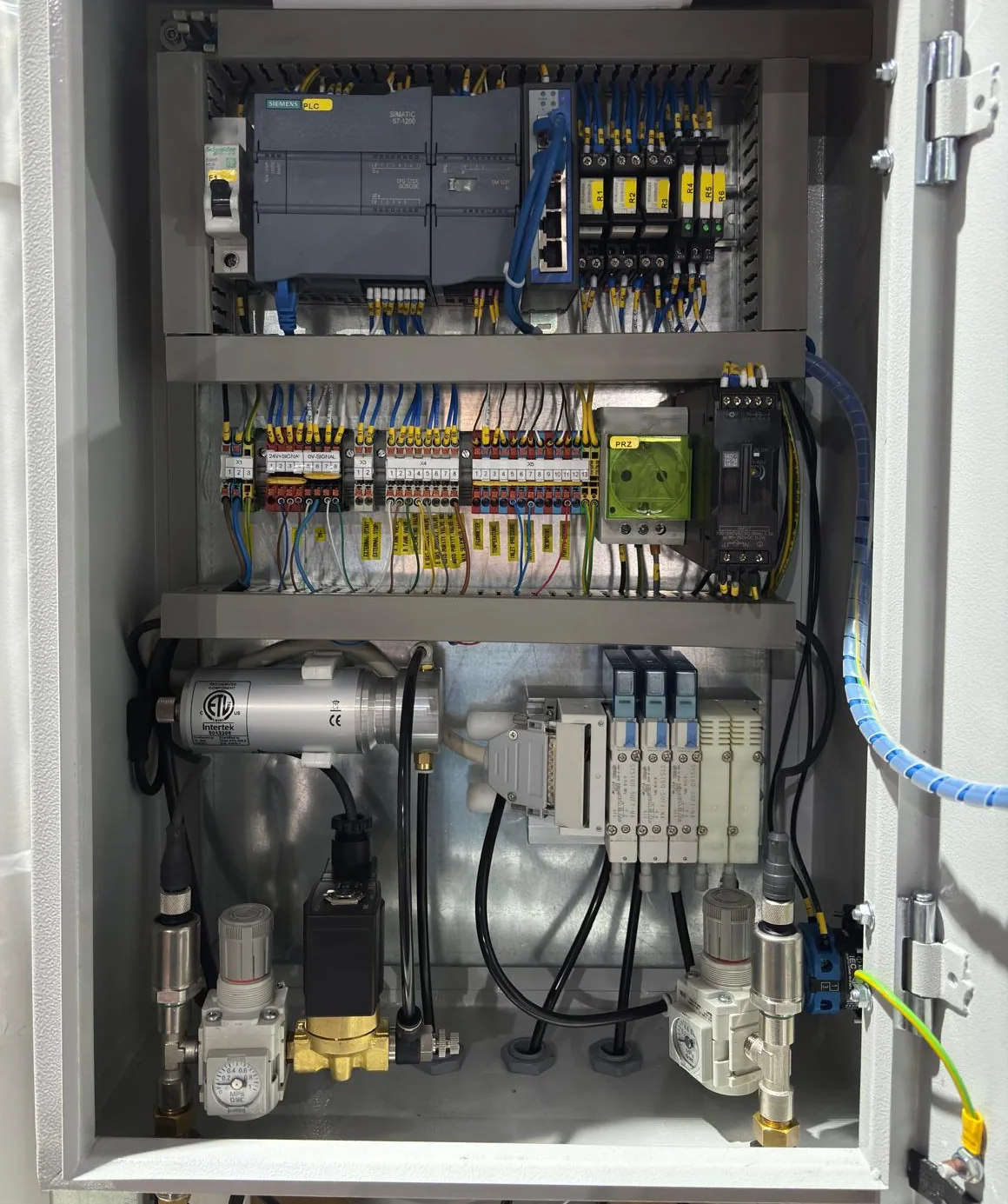
Everything is decided in the control panel

The PLC, the oxygen sensor, the regulators and the solenoid valves that control the gas are in the same cabinet, with every wire numbered and every terminal identified. That way a fault is found in minutes, not hours.

Control panel of a nitrogen plant: Siemens PLC, labelled terminals, oxygen sensor, regulators and solenoid valves

Three ways to supply technical gas

Each option has a different cost and operating profile. An on-site generator is usually the best option from medium consumption upwards.

High-pressure cylinders
  • Highest €/Nm³ cost on the market
  • Logistics risk in handling and storage
  • Interruptions for cylinder changes
  • Working pressures of up to 300 bar
  • Suitable for very low or occasional consumption
Cryogenic tank (liquid)
  • Intermediate cost, lower than cylinders
  • Monthly rental of tank and vaporiser
  • Total dependence on the supplier and deliveries
  • Boil-off losses: 5–15% per month
  • Suitable for medium consumption without predictable peaks

Types of PSA generators

There are two main configurations. The choice depends on the scale of consumption, the purity required and future expansion needs.

Twin tower (classic PSA)

Two columns of CMS (N₂) or zeolite (O₂) alternating adsorption and regeneration cycles. Robust design for large continuous flows.

Capacity High
Scalability Limited
Maintenance More complex
Initial cost Higher
Best for Large scale, high purity
Modular (columns in parallel)

Multiple independent modules connected in parallel through upper and lower manifolds. Each module acts as a self-contained tower.

Capacity Scalable
Scalability High
Maintenance Modular, no shutdown
Initial cost More affordable
Best for Medium scale, future expansion

Components of a generation plant

Compressor
Lubricated or oil-free. Supplies air at 7–10 bar. Sized according to target flow and purity.
Refrigerated dryer
Lowers the air dew point to +3°C or below. Essential to protect the adsorbent.
Air filters
Coalescing, particulate and activated-carbon filters. They ensure ISO 8573-1 Class 1.4.1 at the generator inlet.
PSA generator
Separation module with CMS (N₂) or zeolite (O₂) columns, Siemens PLC control panel and zirconia O₂ sensor.
Buffer tank
Stores the gas produced, regulates outlet pressure and absorbs the process demand peaks.
Purity analyser
Zirconia-technology O₂ sensor. Continuous measurement 0–21% / 0–1000 ppm. Integrated in the PLC.

Preventive and predictive

A structured maintenance programme keeps the generator efficient and maximises its service life. We combine periodic inspections with continuous monitoring of key parameters.

Daily — visual
HMI panel status

Check of the touchscreen indicators: purity, inlet pressure, active cycles and no alarms.

Every 3 months / 2,000 h
Inlet air quality

Dew point check, leak detection, check of pressure gauges during purge and inspection of cables and electronics.

Every 3 months / 2,000 h
O₂ sensor check

Check of the oxygen analyser reading. Comparison with a calibrated external sensor if drift is detected.

Every 6 months / 4,000 h
PSA cycles and regeneration

Check of adsorption, regeneration and equalisation times against the manufacturer's specifications. PLC adjustment if needed.

Every 12 months / 8,000 h
Filter replacement

Replacement of SF (0.1 µm) and PF (0.01 µm) filter elements, filter drains and sterile filters at the N₂ tank outlet.

Every 24 months / 16,000 h
Service D — complete valves

Replacement of switching valve kits, silencers and O₂ sensor, and general calibration. An essential intervention to guarantee purity.


What we check on each visit

A maintenance plan covering the whole line, from the compressor to the point of use. Choose 2 or 4 visits a year and tap each unit to see the details.


Most common faults

Most faults in PSA generators have identifiable causes and standard solutions. A systematic 4-step diagnosis cuts resolution time by 60%.

Symptom Usual cause Recommended action
Low N₂ purity
Saturated filters, solenoid valve not closing, sensor out of calibration
Replace filters → manual valve test → recalibrate analyser
PSA cycle alarm
Stuck solenoid valve, PLC timer mismatch, faulty pressure sensor
Individual valve activation → review of PLC parameters → sensor replacement
Moisture in the system
Faulty dryer, automatic drains blocked
Check dew point with a hygrometer → check drains → assess dryer desiccant
Low output (Nm³/h)
Inlet pressure below 7 bar, exhausted adsorbent, leak in the circuit
Check compressor and regulator → leak test → adsorbent analysis
Abnormal back-pressure during purge
Clogged silencer, vent valve partly closed
Inspect silencers → replace if differential pressure exceeds 0.2 bar

Express diagnosis in 4 steps

Step 01
Inlet check

Check supply pressure, available flow and the compressed-air dew point.

Step 02
Operation analysis

Monitor the pressures of each PSA column and verify equalisation between cycles.

Step 03
Component inspection

Check the condition of filters, solenoid valves and PLC parameters. Identify faulty elements.

Step 04
Outlet check

Measure final purity and available flow. Confirm the product meets specifications.


Request a no-obligation technical consultation

We read your enquiry personally and reply within 48 working hours at most.

Request a technical consultation →
WhatsApp