Many small wineries and bottlers use nitrogen in 200-bar cylinders because “we don't use much”. Sometimes that's true. But the full calculation has rarely been done, and when it is, the surprise is usually the same: a Nm³ of cylinder nitrogen costs much more than the invoice suggests.
How much gas is really in a cylinder
A 50-litre cylinder at 200 bar holds about 10 Nm³ of nitrogen. But not all of it is used: the cylinder is changed when pressure is no longer enough for the process, and goes back to the supplier with gas still inside. Depending on the minimum pressure you need, between 5 and 10 % of the gas you pay for returns unused.
The items people forget
The refill price is only part of it. To know the real cost you have to add up everything it takes to have cylinder nitrogen for a year:
- Gas refills.
- Rental of cylinders or bundles, paid even when they sit full in the store.
- Transport and delivery surcharges, especially for urgent orders.
- The gas that goes back unused in each cylinder.
- Your team's time changing cylinders, and line stops when one runs out mid-production.
Divide the total by the Nm³ you actually use and you have your cost per Nm³. In one of our cases, a workshop buying about 40 cylinders a week, it came to about €2.19 per Nm³.
What it costs to produce it
A PSA generator produces nitrogen from compressed air. At 99.5 % purity, which is usual for inerting in wineries, it needs around 0.3 kWh per Nm³, compressor included. At industrial electricity prices that is a few cents per Nm³. Add annual maintenance and depreciation of the equipment, and the difference with cylinders is still usually an order of magnitude.
There is an advantage that doesn't show in the numbers: the generator produces exactly the purity you need. With cylinders you pay for 99.999 % gas for a process that often works perfectly at 99.5 %.
The case of a wine bottler
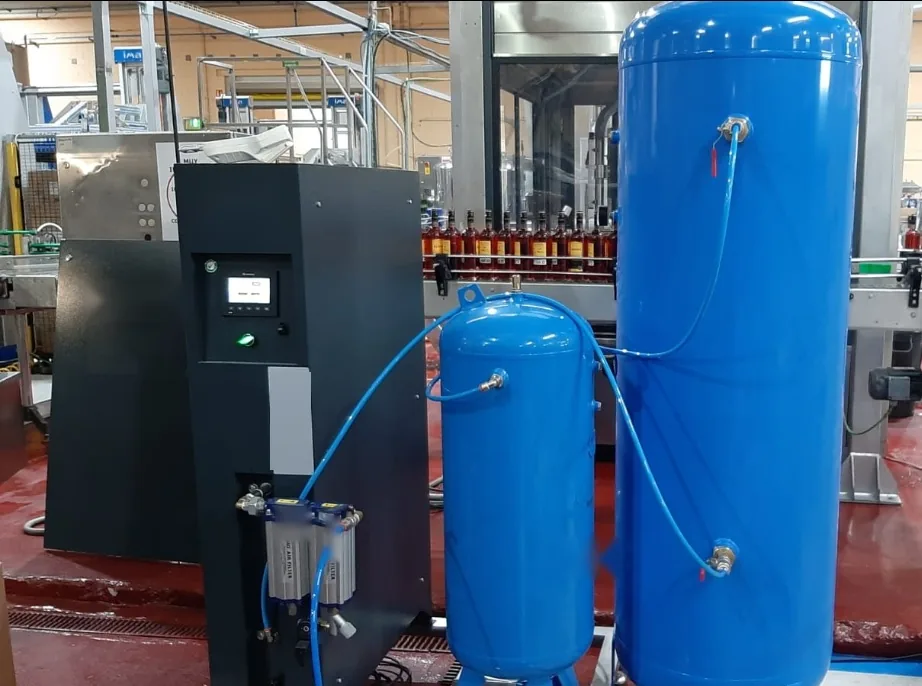
A bottler in the Tarragona area inerted its filling line with 200-bar cylinders. We installed a compact skid-mounted plant, with a modular PSA generator and buffer tank next to the filler, and a stainless-steel sterile filter at the point of use. Annual maintenance includes the nitrogen quality certificate.
Compared with what it paid for cylinders, the investment pays back in about 8 months. Since then the line has not stopped for lack of gas.
When doesn't it pay?
If you use very little and only occasionally (a few cylinders a year), cylinders remain the sensible option. The generator starts to win when consumption is regular: every week, every bottling run, every racking. And the more regular, the sooner it pays.
If you have no investment budget, there is also renting: a fixed monthly fee that, in many cases, is lower than the cylinder bill it replaces.
How to do the calculation
Gather the last twelve months of invoices (refills, rentals and transport) and note how many cylinders you change. With that and your process, we work out the flow and purity you need, the cost of your current Nm³ and what it costs to produce it yourself. You can start with the nitrogen calculator.