When nitrogen inerts a wine tank, protects olive oil, fills the headspace of a bottle or forms the atmosphere of a pack, it stops being a plant utility: it is the food additive E 941, with a specification set by Regulation (EU) No 231/2012.
Food-safety standards (IFS Food, BRC and ISO 22000) and many customers require you to prove compliance with documented evidence. A working generator is not enough: you have to be able to show it.
If you produce your own nitrogen, you are the gas manufacturer. And the soundest way to prove its quality is a certification by someone independent of whoever sells or maintains it.


“It’s not a marketing question. It’s a sense of responsibility.”
The cost of certification can easily be passed on to the price of the product. Consumers demand quality, and nitrogen certification guarantees it.
A certificate is only worth something if it reflects a plant in good condition. That is why, before certifying the nitrogen, we ask for two things.
Compressor, drying, filtration, generator and receivers must have their preventive maintenance done before certification. Certifying a plant with saturated filters or an unchecked dryer means certifying a result that may not last a week. If yours is not up to date, we can do it before certifying, with our maintenance service.
Nitrogen is produced from compressed air, and its quality starts upstream, in the compressor room. The customer must verify and document the quality of the air feeding the generator to ISO 8573-1, with maintenance of the compressor, drying and filtration and, where applicable, measurement of air quality.
A qualified technician certifies the nitrogen quality at your installation, without stopping production.
We do not depend on your generator's manufacturer or on whoever services it. We certify plants of any brand.
The certificate is signed with a qualified electronic certificate: anyone can verify who signed it and that nobody has altered it.
We remind you when renewal is due, ahead of your next audit.
Four questions and you will know.
01Does the nitrogen touch the food, the drink or its packaging?
02Do you have IFS, BRC or ISO 22000 audits, or do your customers require them?
03When was the nitrogen quality last certified?
04Since then, have there been faults, expansions or changes to the plant?
We will tell you whether you need certification and when to do it.
Together with the annual plant inspection, so you always have valid evidence.
To arrive with the documentation ready and no surprises.
To confirm that the repair has brought the gas back to specification.
When a generator is added, the network changes or new points of consumption appear.
To start with a documented reference from day one.
Major retailers and brands increasingly ask their suppliers for evidence.
A paper certificate or an ordinary PDF can be changed without leaving a trace. Ours are signed with a qualified electronic certificate: any PDF viewer shows who signed it and whether the document is still intact.
If anyone changed a single figure, the signature would no longer be valid. For an auditor, that is the difference between a statement and evidence.
It is nitrogen as a food additive. When the gas comes into contact with a food, a drink or its packaging (inerting, modified-atmosphere packaging, bottling), it stops being a plant utility and becomes a technological ingredient, with a specification set by Regulation (EU) No 231/2012.
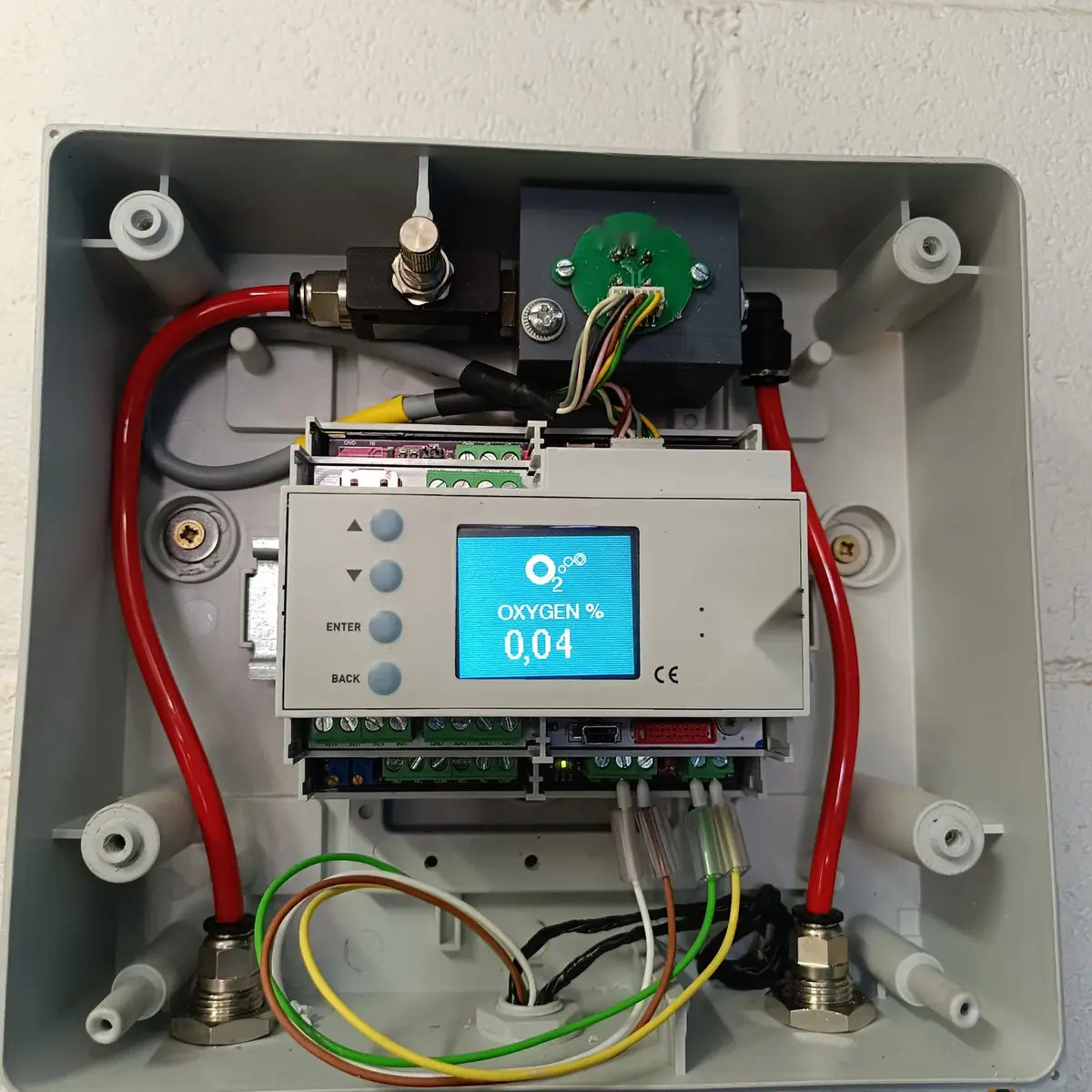
It is essential for day-to-day control, but it does not replace an independent verification. The generator's analyser is adjusted and maintained by whoever installs or services the plant, and it can drift over time. Auditors value a measurement made by a technician who is independent of the equipment, with their own calibrated instrumentation, documented in a certificate that cannot be altered.
Usually once a year, together with the plant inspection or before the audit. It is advisable to repeat it after a fault, a major service, an expansion or a change in the process that uses the nitrogen.
Two essential things: preventive maintenance of the whole plant up to date (compressor, drying, filtration, generator and receivers), and documentation proving the quality of the compressed air feeding the generator to ISO 8573-1, which is the customer's responsibility.
Without them, the nitrogen certification is open to question by the auditor. If maintenance is not up to date, we can carry it out before certifying.
Yes. We certify the nitrogen quality of generators of any brand, and also of installations with mixed supply. The certification is independent of the manufacturer and of whoever maintains the plant.
We tell you on the spot, with the most likely cause and what needs to be done to correct it. Once corrected, we repeat the measurement and issue the certificate. If you need it, we can also take care of the correction with our maintenance service.
Because it guarantees two things an ordinary PDF does not: who signed it and that nobody has changed it since. Any PDF viewer shows whether the signature is valid, and if anyone changed a single figure, the signature would no longer be valid.
Throughout Spain.
Fill in the request and we will propose a date to certify your nitrogen. No need to go through the contact page.
We reply within 48 working hours with a date and what we need from the plant.
We measure at the points of use with a calibrated analyser and check the generator.
You receive the digitally signed certificate, ready to show the auditor.